Gender-based occupational segregation: A multi-country analysis
Abstract
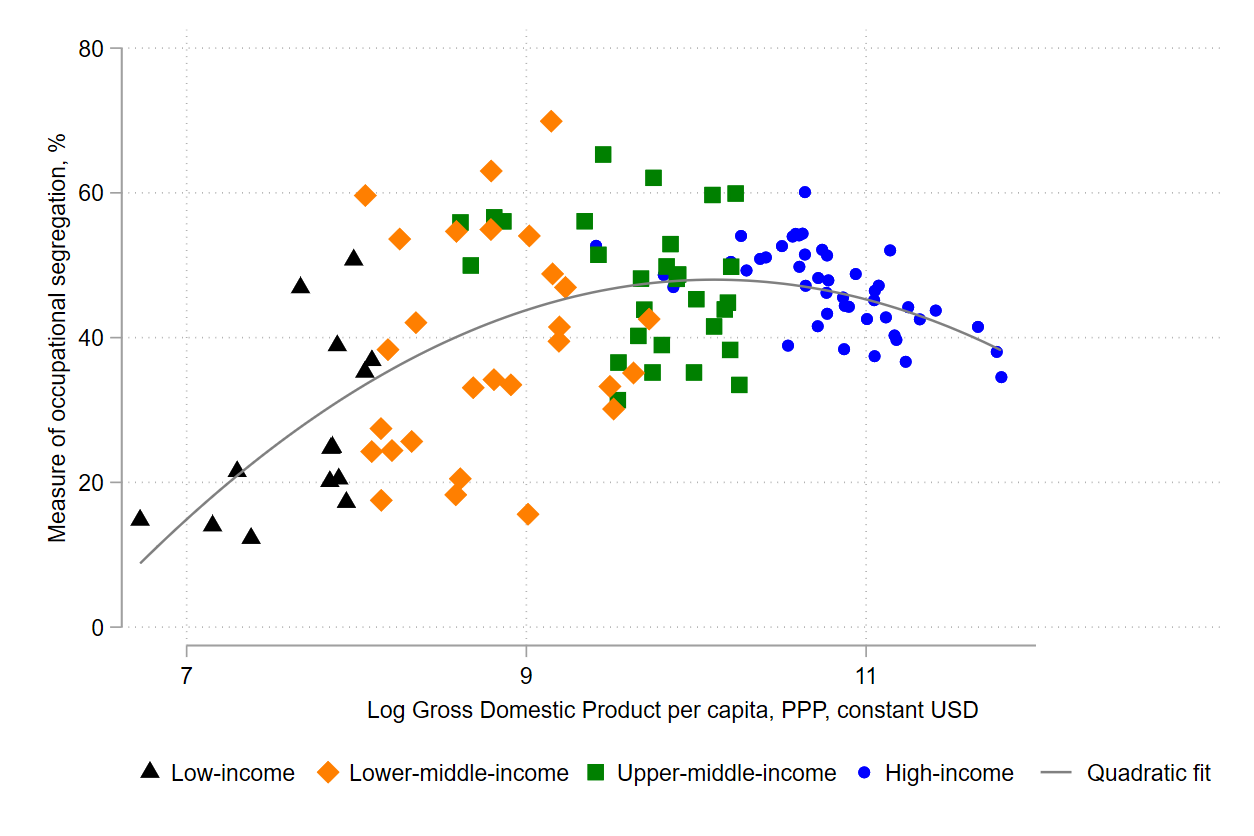
Gender-based occupational segregation remains a feature of labour markets worldwide, with crucial implications for wages, working conditions, and economic opportunities. While extensively studied in high-income countries, less is known about how segregation varies across countries at different stages of development and how it evolves over time. This paper addresses this gap using harmonized microdata covering 117 countries - representing approximately 65.5 per cent of global employment - and a panel of 75 countries over the period 2010-2014 to 2020-2024. The analysis documents three main findings. First, occupational segregation is high globally: 39.8 per cent of working women would need to change occupations to match men’s distribution, with only limited progress in reducing segregation over the past decade. Second, segregation follows an inverse U-shaped relationship with economic development. We refer to it as a Kuznets curve for gender-based occupational segregation. Third, a decomposition of changes in segregation shows that gender imbalances within occupations have narrowed across countries, but that in developing economies these improvements are partly offset by shifts in employment toward more segregated occupations such as Sales workers. These results highlight the central role of structural transformation in shaping segregation dynamics and imply that policy priorities differ by level of development.

Rémi Viné
Lecturer, Faculty Lead, and Technical Officer
My research relates to migration topics (choice of mobility, impact of remittances on the left behind, the costs of transferring money, etc.), and to cross-border capital (FDI and remittances).